Cuban Casino
Salsa the way Havana dances it. Casino is Cuba's own partner salsa: circular, playful and grounded, born in Havana social clubs in the 1950s and still danced in every Cuban town.
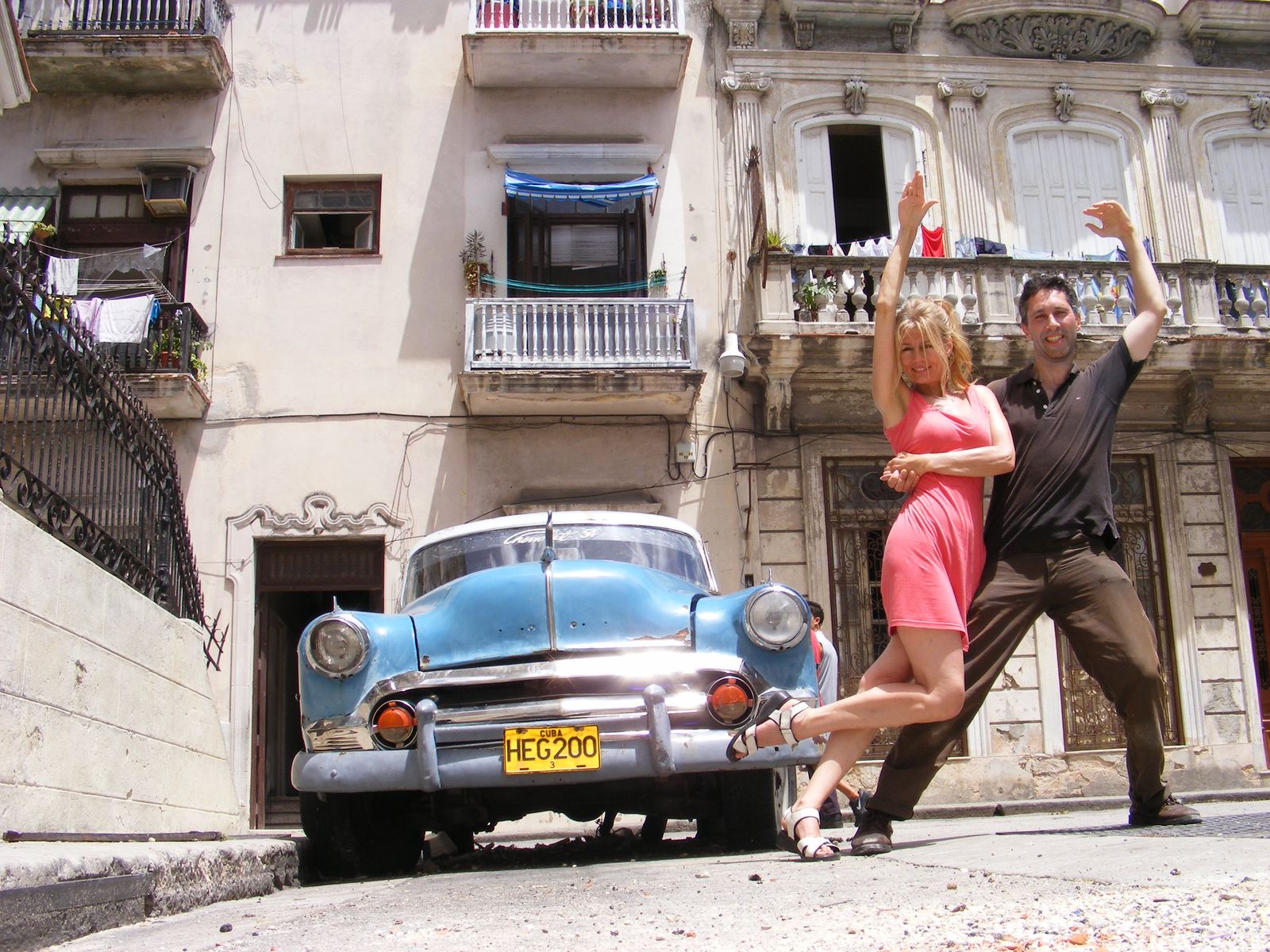
Casino on a Havana street: Anthonydpadgett, CC BY-SA 4.0
Where casino came from
In 1950s Havana, young dancers in the social and sporting clubs, known as casinos, began mixing the old son with cha-cha-chá, mambo, rumba and ideas from American swing. Couples turned around each other, swapped places and wove arms into knots, and the new style simply took the name of the clubs where it was danced.
After 1959 the private clubs changed, but the dance stayed in homes, schools, house parties and community centers. It became Cuba's everyday social dance, passed from cousins to neighbors rather than taught in studios.
Video: BASIC STEPS FOR CASINO pt 1 // "Cuban Salsa" (Messina Dance), embedded from YouTube.
How it feels on the floor
Casino moves in circles. Instead of dancing in a straight slot, the couple orbits a shared center, so the floor feels like a set of small spinning galaxies. The leader often walks around the follower as much as he turns her, and the body stays relaxed, with knees soft and weight low.
Arm work is the signature. Figures such as the enchufla, the sombrero and the setenta wrap partners together and then release them, and good dancers make even complex knots look calm and unhurried.
Timing is flexible. Most casino is danced with the break on 1, but many Cubans step a little behind the beat or add a tap, and some dance a contratiempo, closer to the second beat. What matters is staying with the clave and with your partner.
The vocabulary of casino
Casino figures carry Spanish names that double as calls in the rueda. Guapea is the open back-and-forth basic, dile que no moves the follower from one side to the other, and vacílala is a free turn where the leader shows off his partner. Learning the names is half the fun, because many figures were named with a wink.
Cuban dancers also love afro-Cuban styling. Shoulder rolls, torso ripples and touches of rumba or orisha dance appear between figures, especially when a timba band hits a heavy break.
Why dancers love it
Casino is social first. You do not need a big slot or flashy tricks, and a beginner can join a circle of friends after a few lessons. The style rewards connection, musicality and humor, which is why casino schools now thrive from Miami to Berlin to Tokyo.
If you visit Cuba, the best classroom is a Saturday night at a casa de la música or a neighborhood party. Watch how dancers change figures with tiny signals in the hand and shoulders, and how they laugh when a move goes wrong. That easy confidence, more than any single pattern, is what makes casino feel Cuban.
Facts on this page were checked against these sources.
- Casino on a Havana street: Anthonydpadgett, CC BY-SA 4.0
Text written by Salsa Tranquila.